Owners and projects
People and companies own resources. Memberships define administration, contribution, reading or audit. A contributor does not become a global administrator.
People, organizations and clients collaborate with their owners’ permissions.
People keep their own buses and devices, share selected agents with an organization and authorize more distant destinations. The bus enforces the rules; Studio manages them. Company names are not hardcoded.
Implemented and tested functionality. Each connection or channel requires configuration and permission.
Integration documented, not enabled yet.
Improvements analyzed, without a delivery date.
This route is an example, not a mandatory hierarchy. A link grants no work. Every federated bus has one authority; legacy full-log replication remains separate so it cannot bypass permissions.
People and companies own resources. Memberships define administration, contribution, reading or audit. A contributor does not become a global administrator.
Private owners grant or revoke actions for each bus, including distant ones. Inbound/outbound grants, project, origin, expiry and hops must agree. A deny takes precedence.
Local/remote repositories, project folders, AI accounts and offline local LLMs. Registering a reference does not clone a repository or execute a command.
Organizations may require more than one administrator to connect remote organizations or people. Revocation is checked again before work begins.
Votes count distinct current administrator people. Two agents owned by one person provide one vote; a negative vote vetoes the connection.
Weakening an active quorum requires an exact proposal approved under the previous policy. One administrator may revoke access without silently weakening the rule.
Delegation retains its origin and checks subsequent destinations. Knowing a neighboring bus does not automatically extend trust.
Running work stays cancellation-requested until its closure is known. Revocation is never presented as proof that a process has stopped.
| Step | Control | Evidence |
|---|---|---|
| Connection | Additional inter-bus credentials | Signature, nonce, time window and authenticated receipt |
| Approval | Current quorum and permissions | Author, vote, revision and exact policy |
| Delegation | Two grants and private consent | Project, resource, origin, hops and idempotency |
| Optional AI | Local or remote Oraculum | Decision on the authorized task and destination |
| Intervention | Reported usage and versioned tariff | Tokens, time, currency and missing data |
Five new views for people and administrators. Historical global views remain restricted to declared operators. The server reauthorizes every action.
Spanish, English, Portuguese, French and Chinese. Expiring sessions, preferences and themes. Account secrets never persist in the browser; organizations do not acquire collaborators’ private nodes.
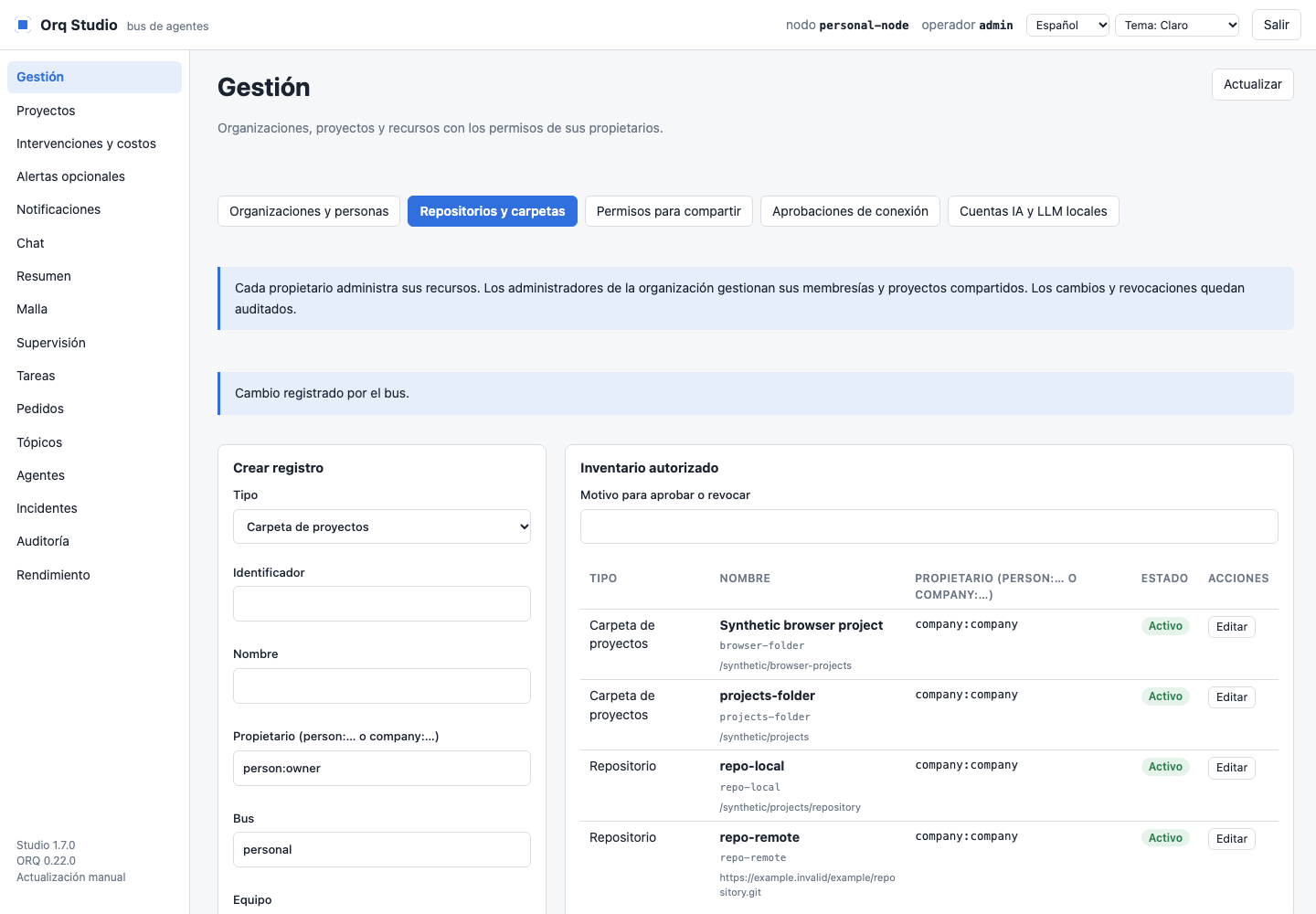
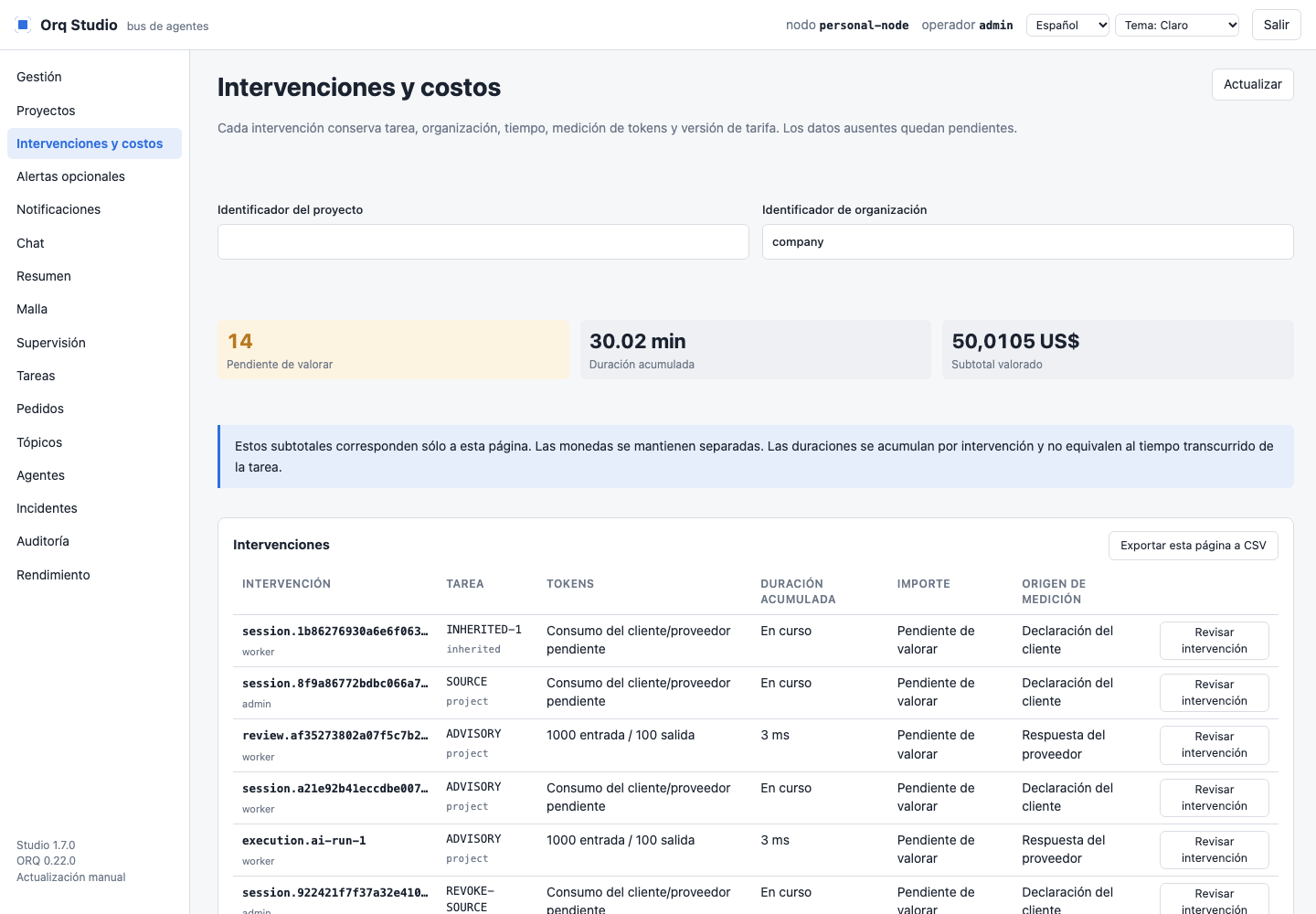
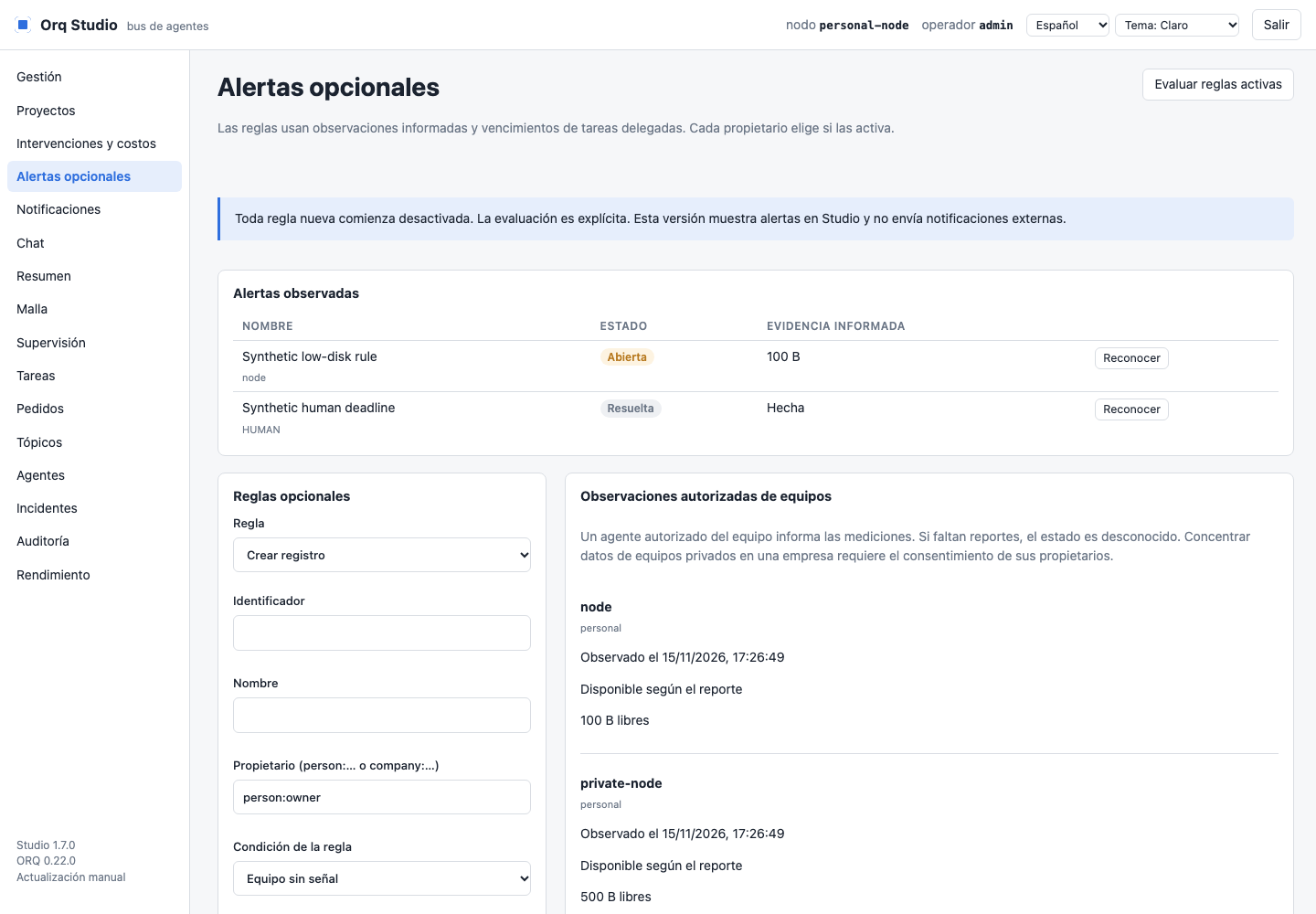
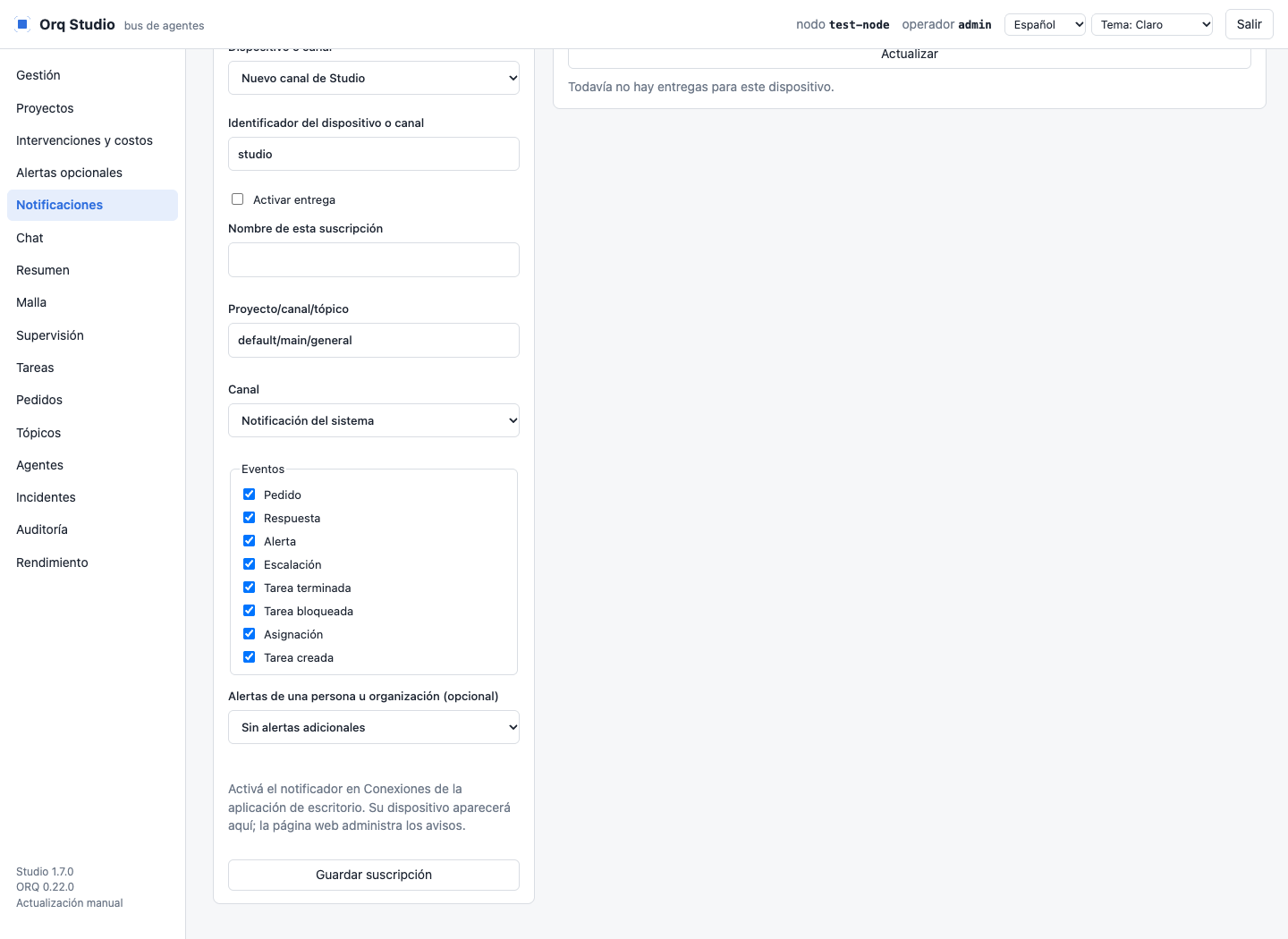
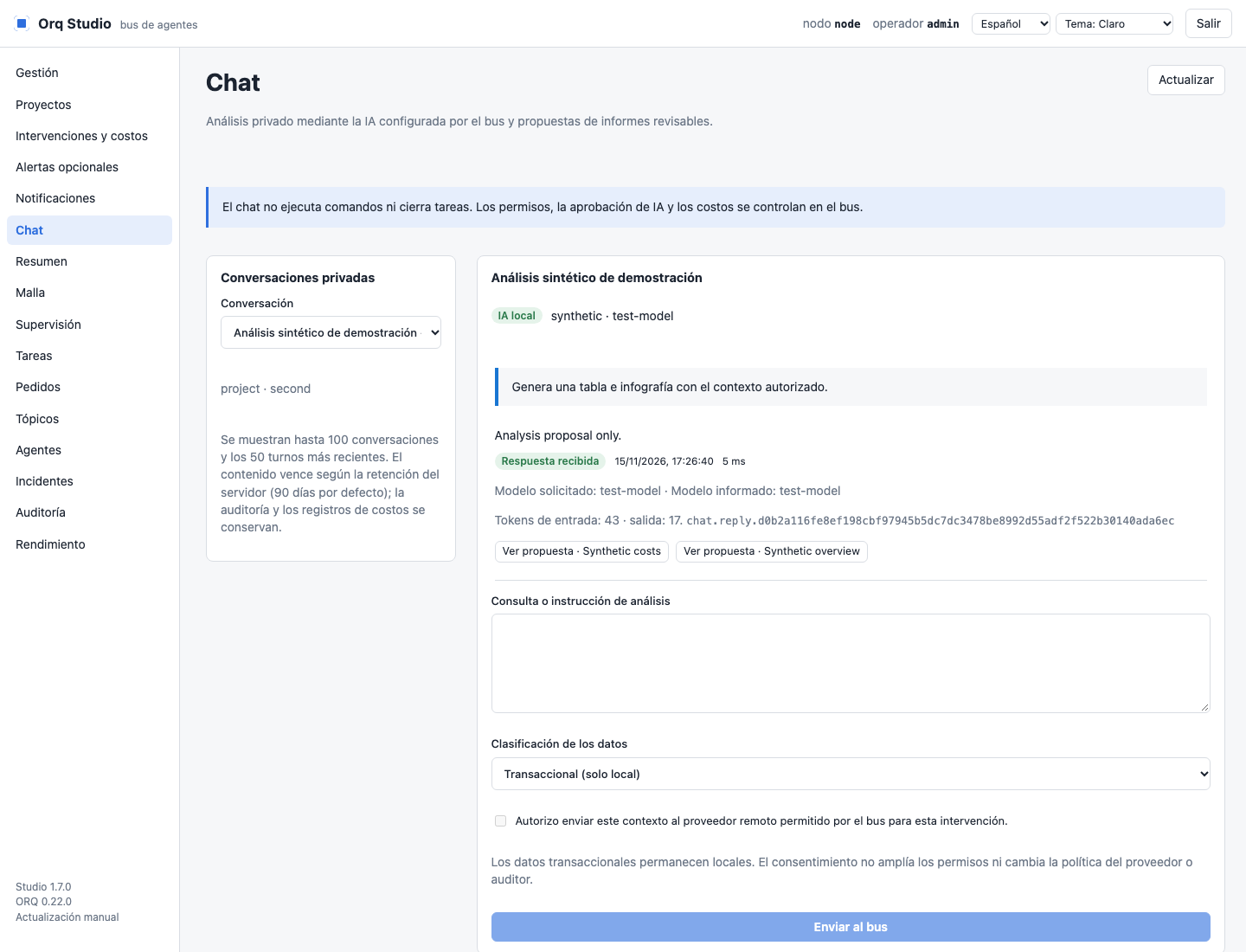
Spanish captures from an isolated bus using fictitious data. Numbers are not actual organization costs or status.
Link secrets differ from agent credentials. Signed receipts keep an unknown outcome from being reported as confirmed.
Accepted and rejected operations enter an immutable chained log. Credentials are excluded; external backups and anchors remain necessary against replacement of the entire database.
Oraculum account tokens use server-side AES-GCM. Provider credentials remain in Oraculum. Offline local models are optional.
Audit may be disabled, advisory or required. Unavailable AI or invalid output cannot authorize required work; approval never creates new rights.
Availability, link, disk and task-deadline rules start disabled and are evaluated explicitly. Notifications can use configured local/SCP channels.
Organizations aggregate their nodes and private observations shared by owners. Task deadlines are facts, not an inference about private human activity.
An intervention ledger separates measurement from valuation. Studio subtotals cover the authorized page and keep currencies separate; they are neither grand totals nor task wall time.
AAP calls retain returned usage and monotonic time. External clients report their usage; missing data stays pending and unpriced.
Billable human labor is declared rather than inferred from waiting. Tariff revisions are selected at start; editing prices never rewrites history.
Assessment notes retain authors and self-review flags. Authorized-page CSV exports protect spreadsheet cells against formulas.
Private chat attached to a claimed task. The BUS checks permissions, consent and AI review before and after inference; every call retains tokens, time and the reported model.
Durable queue and idempotency: retrying a submission retrieves its result. Unknown outcomes never trigger an automatic duplicate inference.
CSV tables for Excel/Sheets, HTML infographics and JSON with revision and hash. People accept or reject with a reason; the model cannot execute commands or complete tasks.
Local or remote AI according to configuration. Transactional data stays local; every remote submission needs consent. Unconfigured accounts or channels are not labeled active.
Optional BUS-managed notifications without an open AI client. Studio manages subscriptions and history; Electron delivers system notifications and SCP connects configured remote channels.
Choose a profile, identity, token and scope. Each subscription selects events and can be disabled. The BUS checks permissions when preparing and delivering a notification.
The queue preserves pending notifications during disconnection. Retries have limits and backoff; uncertain remote outcomes remain for review.
Electron stays in the tray when Studio closes. System permission is required to show notifications; Quit stops the application. Automatic startup is not enabled.
Notify.Send preserves the provider outcome and correlation. Use requires deploying the updated contract, configuring the channel and enabling an authorized recipient.
OS display, provider acceptance and human acknowledgment are recorded separately. Clicking opens Studio; it never approves, executes or completes tasks.
Secrets use the operating system’s protected store and are not exposed to the web page. Delivery makes no AI call; unknown channel charges remain unpriced.
| System and architecture | Package | Verification |
|---|---|---|
| macOS ARM64 | DMG | Execution, login and notifications checked |
| Windows x64 | ZIP | Package verified; native testing pending |
| Windows ARM64 | ZIP | Package verified; native testing pending |
| Linux x64 | TAR.GZ | Package verified; native testing pending |
| Linux ARM64 | TAR.GZ | Package verified; native testing pending |
Every version loads the node’s Studio and retains its login and permissions. Windows and Linux are portable evaluation packages with SHA-256 checksums; testers must validate them on native machines.
Private chat attached to a claimed task. The BUS checks permissions, consent and AI review before and after inference; every call retains tokens, time and the reported model.
CSV tables for Excel/Sheets, HTML infographics and JSON with revision and hash. People accept or reject with a reason; the model cannot execute commands or complete tasks.
Pending: aggregated portal reports, XLSX/PDF and editing or execution tools. Reviewing a proposal does not grant permissions.
Resident health collectors and automatic rule evaluation remain next-stage work. Local/SCP delivery is implemented; channels require explicit activation.
Immutable adjustments for late usage or tariffs, budgets and inter-organization cost agreements. Current missing data remains pending.
Larger directories, KMS, external audit anchors and redundant authorities with consistency rules.
The historical mesh keeps its tasks. A new authority is configured separately; installing or activating a model does not export or reset history.