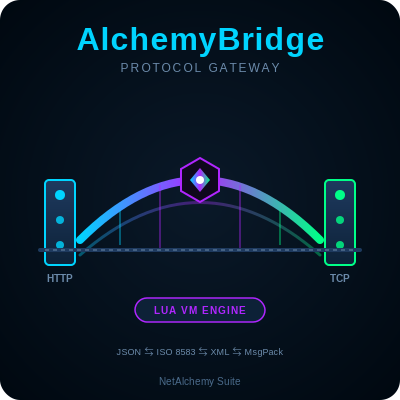
Your rules engine,
in production today.
A single binary that runs your transactions with chained rules and replaces the multi-process legacy stack. Whatever matures here, the switch inherits.
AlchemyBridge is the bridge between what you already have running and the next generation: put the rules model into real traffic without waiting to rewrite the whole system and without retraining your team.
With the legacy stack
- Processing is spread across several processes (server, adapters, offline retries) that have to be run and watched separately.
- Every logic change forces a redeploy and restart: a downtime window, risk and coordination.
- Business logic stays trapped in thousands of tightly coupled lines, hard to touch without breaking something else.
- A single thread caps performance under load.
With AlchemyBridge
- One binary runs server, adapters and offline retries together: fewer moving parts, lower operating cost.
- You change a rule and hot-reload it, without taking the service down or restarting.
- Logic is written as atomic, versionable and auditable rules — the business is easy to understand and quick to change.
- A concurrent core proven at the scale of thousands of transactions per second.
Why adopt it now
Business in rules, not in code
The transaction is assembled by chaining rules that call other rules. The "pipe" (network, encryption, database) doesn't mix in financial logic: a clean separation and simple maintenance.
Hot changes
You update rules and reload with no downtime. You iterate on behavior in minutes, not in deployment windows.
One binary, not three processes
Server, protocol adapters and offline retries live in a single executable with its plugins. Less infrastructure to operate.
Real performance
A concurrent core with a rule-execution pool, measured at the scale of thousands of TPS — far beyond a single-threaded server.
Multi-protocol and multi-transport
It speaks the transports your integration needs —HTTP, TCP, NNG, MQTT, ZeroMQ and serial port—, each one an optional plugin, and supports the protocol adapters you already use, migrated one by one.
A path without a big bang
You replace in stages: first the adapters, then the offline retries, finally the core. The legacy stays in the loop until each piece is ready.
Periodic tasks without external cron
A native engine clock fires rules on a schedule: host session keepalive, offline reversal retries and scheduled refreshes — with built-in overlap protection (never two runs at once) and a timeout. No fragile cron outside the system.
A host session that's always live
For hosts that demand a persistent connection (ISO 8583/TCP with sign-on), the engine keeps the session alive: sign-on, keepalive EchoTest and transactions all travel over the same live connection. No links dropped over a missed echo, and with each host's frame format resolved by configuration, not by code.
Real transactional integrity
Group several database operations into one atomic transaction (all or nothing), with row locking translated to each engine (PostgreSQL, MySQL, Oracle, SQL Server). And a golden rule of the payments business: the engine never keeps a transaction open waiting on the host, so no transactions are left hanging and no locks jam the database.
Unique numbers and cross-node coordination
The engine generates transaction numbers (the ISO 8583 STAN) atomically —never two the same, even with thousands of operations running in parallel on the same terminal— and coordinates work across several nodes with distributed locks. No duplicate STANs and no double processing, even as you scale horizontally.
Retries and batches that are never lost or duplicated —now in parallel
When an operation doesn't reach the host, it isn't discarded: it stays pending and retries on its own, in ordered batches. And now it processes many terminals at once, in parallel, keeping order within each one: if one fails, it's isolated and the rest carries on. The classic "store-and-forward", now faster, driven by rules and with no custom code —an integration pattern we didn't have before.
Rules are designed, not typed
Alchemy Studio: the visual designer for rules and flows. It validates with the same engine that runs in production, saves touching only what you changed, and keeps history and audit. In the browser, on the desktop or for the whole team.
Authorization and issuance, in rules
Payments are the most demanding case, not the only one. For issuers, acquirers, aggregators, gateways, merchants and banks, the same runtime chains rules for transaction authorizers and for issuance flows.
Authorizers
Authorization host with rules for limits, fraud, network routing and merchant response — change logic with no redeploy or downtime window.
Issuance
Orchestrate product onboarding, personalization, embossing and activation as chained rules: card programs that evolve at business speed.
The same engine, inside your process: libnetalchemy
When you don't want a service, the full engine embeds as a native library. Your application passes an object in its own language and gets one back — rules, security and data access travel inside. Meet libnetalchemy in detail →
And when that engine becomes a full product through pure configuration, a Compound is born: Oraculum, an AI Gateway built on AlchemyBridge without a line of code →
And with declarative persistence another Compound is born: Tessera, credentials and tokens (mTLS management + auth) built on AlchemyBridge without a line of code →
All your languages
Tested in C, C++, COBOL, Python, Node/Bun/Deno, Java, Kotlin, Scala, Ballerina, Rust, Elixir, C#, Swift, Dart, PHP, Ruby and LuaJIT — using each runtime's native integration model.
From the mainframe to the pocket
A COBOL banking core uses it with a CALL; an Android APK and an iOS app take it on-device; a gateway loads it in its plugin. One engine, byte-exact everywhere.
Zero dependencies in your app
No database drivers, no crypto libraries, no serializers: the rule resolves it inside. Your application stays clean and auditable.
More transports, serial and Bluetooth pinpads, and resident services
What was added to the runtime in recent weeks, already integrated and tested.
Seven transports, each a plugin
HTTP, TCP, NNG with all its patterns (request/reply, publish, queues, survey, pairs and bus), MQTT 3.1.1 and 5, ZeroMQ (optional CURVE), serial port and Bluetooth SPP. Each one is compiled into the binary, loaded in process or run as a separate plugin, and can be left out.
Pinpads over RS-232 and USB
Declared framing (STX/ETX with LRC, inner length, prefixes), ACK/NAK/ENQ/EOT link control, block transfer to update the device, and the port shared with the cash register. The port is found by vendor and model.
Bluetooth pinpads
Bluetooth SPP as client or server, with the same frames, acknowledgements and block transfer as serial. If the device drops, the line reopens on its own and the client stays connected.
Long-lived Lua services
Resident processes next to the rules, each with its own engine and automatic restart. The branch-mesh node runs on them and installs as a user or system service on Windows, Linux and macOS.
A message inside another
A field's value can be another message, with its own format chosen by condition: for example, field 63 as TLV or as key=value depending on the entry mode in field 22. Byte-for-byte round trip.
Card data kept out of logs
Which fields are sensitive is declared in each format's configuration. The PAN is masked with the pattern each client or country asks for —none, last 4, first 6, 6 + 4, 8 + 4, 6 + 2, 8 + 2— and always keeps its length. Anything undeclared goes through a safety net.
A sturdier Lua engine
We found and fixed five defects in the Go-based Lua interpreter the runtime uses, and sent the fixes to the original project (under review). Tests run on LuaJIT, Lua 5.1, 5.4 and 5.5.1.
Transport-independent security
An own encrypted channel, optional and declared in configuration, over any transport: mutual authentication, per-message encryption and replay protection. Selectable envelope formats and crypto providers, FIPS-approved ones included.
Rules that tell the expected apart, live log levels and what is coming
Capability updates; ORQ updated on 2026-11-14. Each block identifies its status.
Cancelling is not an error
Two error models in the rules: the expected comes back as a value and the rule decides what to do; the unexpected goes to its handler and, if that does not resolve it, to the application's general handler. A called rule handles its own error or passes it up. The same rules run the same way in Adyton.
Live log level
The log level changes while the service runs, with a reload signal, and also reaches the Lua rules, with no restart and no dropped connections.
As a library, with its log
Embedded as a library in another program, the bridge hands it every log line through a callback in the eleven languages with a binding, or through a queue the program reads when it cannot take calls.
ORQ + Studio: federated buses
Personal, organization and client buses with owners, destination permissions and administrator quorums. Studio 1.7.0 manages resources, optional AI, costs, alerts and notifications. Authenticated chat runs through the BUS and proposes reviewable tables and infographics, recording tokens and time per intervention. SCP Notify and Electron 0.2.1 deliver notifications without an open AI client. Each account and channel requires configuration and consent; aggregated portal reports remain next-stage work. Technical details and status.
Modbus TCP and RTU, through metadata
The whole protocol is declared in the configuration —codecs per endpoint, with one layout to read and another to build— and the engine only adds generic capabilities, which serve other protocols too. The full example lives in the repository.